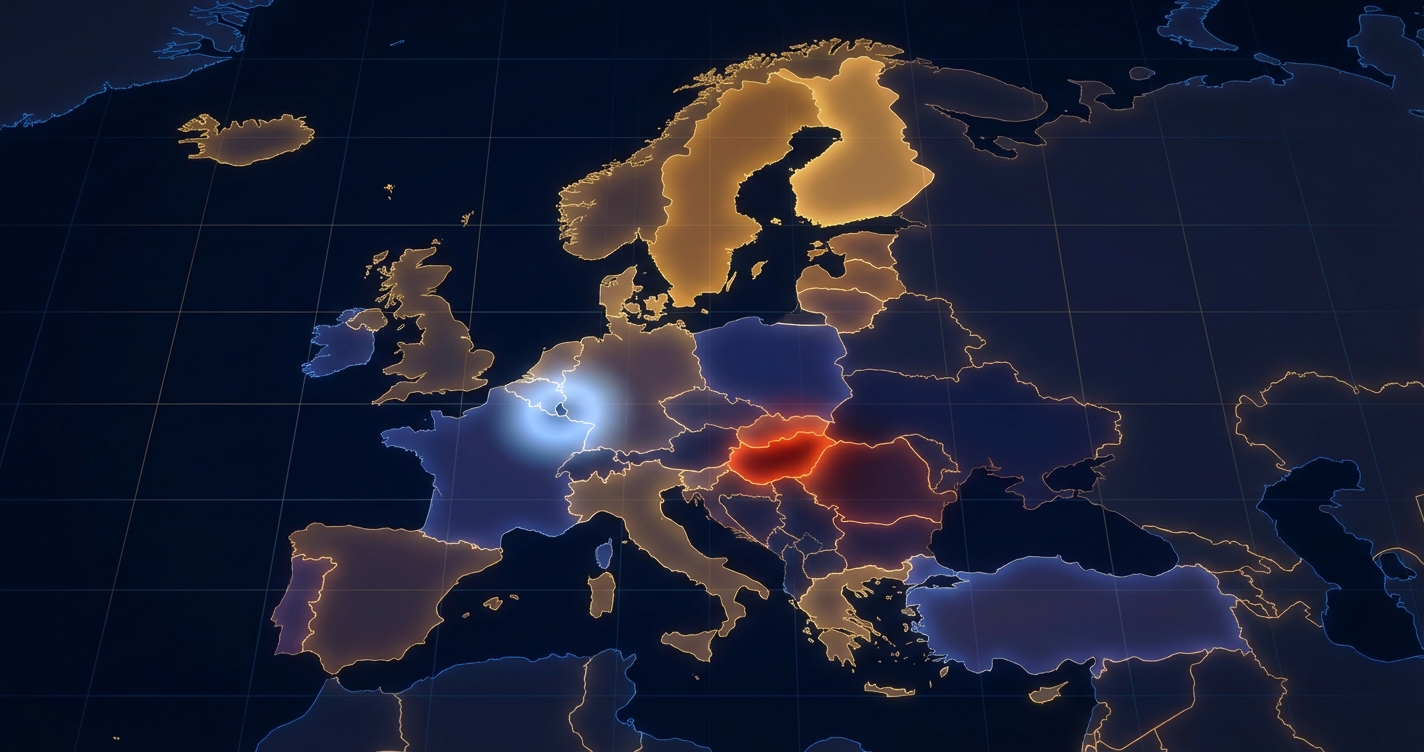
VAT in Europe: From 8% to 27%, What Do These Gaps Reveal?
8% in Switzerland, 27% in Hungary. Nearly 20 points difference. In this Pinnokio ThinkTank analysis, we explore the hidden correlations between VAT, reduced rates, social models, and economic strategy.
title: "VAT in Europe: From 8% to 27%, What Do These Gaps Reveal?" description: "Pinnokio ThinkTank Analysis: why does VAT vary so much across Europe? From Switzerland to Hungary, from reduced rates to societal choices." date: "2026-01-31" author: "Pinnokio Team" tags: ["Pinnokio ThinkTank", "Taxation", "Europe", "SMB", "Analysis"] readingTime: "12 min" series: "Pinnokio ThinkTank"
VAT in Europe: From 8% to 27%, What Do These Gaps Reveal?
Pinnokio ThinkTank — This analysis presents our original reflections based on in-depth research. The hypotheses and correlations proposed are the result of our own analysis and represent Pinnokio's views alone.
Introduction
8.1% in Switzerland. 27% in Hungary. Nearly 20 percentage points difference between two neighboring countries on the same continent.
For an SMB selling internationally, this reality is daily: invoices, rates, and rules that change at every border. But beyond the administrative complexity, these numbers tell a fascinating story. They reveal societal choices, economic strategies, and radically different political balances.
In this analysis, we go beyond comparison tables. We seek to understand why these gaps exist and what they teach us about Europe.
Part 1: The Facts — A Complete Overview
Standard Rates in 2026
| Country | Standard Rate | Position |
|---|---|---|
| Switzerland | 8.1% | Lowest in Europe |
| Luxembourg | 17% | Lowest in the EU |
| Malta | 18% | - |
| Germany | 19% | Largest EU economy |
| France | 20% | Close to average |
| Netherlands | 21% | EU average |
| Finland | 25.5% | Nordic cluster |
| Hungary | 27% | Highest in the world |
EU Average: 21.3%
The Jungle of Reduced Rates
But the standard rate is only the tip of the iceberg. Each country also applies reduced, super-reduced, and even zero rates depending on product and service categories.
| Country | Standard | Reduced | Super-reduced | Accommodation | Restaurant |
|---|---|---|---|---|---|
| Switzerland | 8.1% | 2.6% | - | 3.8% | 8.1% |
| Luxembourg | 17% | 8% | 3% | 3% | 3% |
| Germany | 19% | 7% | - | 7% | 7% (2026) |
| France | 20% | 10% | 5.5% | 10% | 10% |
| Italy | 22% | 10% | 4% | 10% | 10% |
| Hungary | 27% | 18% | 5% | 5% | 5% |
| Denmark | 25% | - | - | 25% | 25% |
Key observation: Denmark is unique — it applies a single rate (25%) to almost everything, without generalized reduced rates. It's the simplest system, but also the "hardest" on consumers.
Part 2: Our Hypotheses — Understanding the "Why"
Hypothesis 1: Switzerland, the Exception That Proves the Rule
The Observation
Switzerland has an 8.1% standard VAT — the lowest on the entire European continent. That's almost three times less than Hungary, and half the European average.
Our Analysis
Switzerland can afford a low VAT because it's not in the EU.
The European Union imposes a 15% floor on its members. Switzerland, not bound by this rule, made a radically different choice.
But it's not just about sovereignty. It's a fiscal philosophy. Switzerland has historically favored:
- Moderate taxation on consumption
- Strong cantonal autonomy (cantons have their own taxes)
- Public services funded differently (contributions, direct taxes)
The revealing detail: Even Switzerland's reduced rate (2.6% for food, medicine, books) is lower than the super-reduced rate in many EU countries.
The Trade-off
Switzerland compensates through other mechanisms:
- High mandatory social contributions
- Mandatory private health insurance (expensive)
- Very high general cost of living
Identified correlation: Low VAT ≠ "Cheaper" country. Switzerland proves that a low rate can coexist with a very high cost of living — VAT is just one lever among many.
Hypothesis 2: VAT as a Mirror of the Social Contract
The Observation
Nordic countries (Sweden, Denmark, Norway, Finland) combine Europe's highest rates (24-25.5%) with the world's best happiness and human development indices.
- Norway: 2nd worldwide on HDI (0.961)
- Denmark: 6th (0.948)
- Sweden: 7th (0.947)
Our Analysis
High VAT isn't a punishment — it's a collective investment.
In the Nordic model, every citizen implicitly understands the equation: "I pay 25% VAT, but in return, I have access to free education through doctoral level, universal healthcare, generous parental leave, and a safety net if my business fails."
This is the "flexicurity" system: society accepts high taxation because it radically reduces individual risk.
The Danish case is extreme: A single rate at 25%, with no reduced rates. It appears brutal, but it's coherent: no niches, no sector lobbying, no complexity. Everyone pays the same.
Identified correlation: High VAT + simplicity ↔ Universal public services ↔ Trust in the state ↔ High happiness.
Hypothesis 3: Luxembourg, the Optimization Laboratory
The Observation
Luxembourg has the EU's lowest VAT (17%) while being the richest country per capita.
Our Analysis
Luxembourg built its model on tax arbitrage.
With 600,000 inhabitants, the country hosts as much foreign direct investment as the entire United States — $4 trillion. Over 75% of corporate tax revenue comes from the financial sector.
But look at the reduced rates: 3% for accommodation and restaurants. That's the lowest in Europe. Why? Because Luxembourg also attracts business tourism and conferences. Every tax lever is a strategic tool.
Identified correlation: Low VAT ↔ Compensation via financial services ↔ Ultra-low reduced rates ↔ Multi-sector attractiveness.
Hypothesis 4: Reduced Rates, or the Art of Political Compromise
The Observation
Most European countries apply between 2 and 4 different rates. Certain sectors systematically benefit from reduced rates: food, medicine, books, accommodation, transport.
Our Analysis
Reduced rates are a social policy tool... and a lobbying one.
The official logic is equity: modest households spend a larger share of their budget on food and basic necessities. Taxing these products less is progressive.
But reality is more nuanced:
-
"Merit goods": Books, press, and culture benefit from reduced rates to encourage their consumption. This is a societal choice.
-
Tourism: Hotels and restaurants often have reduced rates to stay competitive with neighboring countries. This is fiscal competition.
-
Sector lobbying: Why is chocolate taxed differently across countries? Why do diapers have a different rate than feminine hygiene products? These inconsistencies reveal lobby influence.
The OECD paradox: The OECD regularly criticizes reduced rates. According to them, they're ineffective for achieving equity (the rich also consume food), costly to administer, and create distortions. They recommend direct transfers to modest households instead.
Our hypothesis: Reduced rates persist because they're politically easier to maintain than remove. No government wants to be the one that "raises VAT on bread."
Hypothesis 5: High VAT and Shadow Economy — The Vicious Cycle
The Observation
IMF research shows a correlation between high rates and the "tax gap" (difference between theoretical and collected VAT). Bulgaria (29.4% shadow economy), Romania, and Greece illustrate this phenomenon.
Our Analysis
The higher the VAT, the greater the temptation to commit fraud.
A restaurant owner billing "without VAT" saves their Hungarian customer 27% while keeping a higher margin. The incentive is enormous.
Studies show that a system with few rates and a moderate standard rate is least susceptible to fraud. Denmark, despite its 25%, has a low shadow economy (~12% of GDP) thanks to its system's simplicity and social trust.
Identified correlation: Complexity (many rates) + high VAT ↔ Fraud ↔ Fiscal erosion ↔ Pressure to increase ↔ Vicious cycle.
Hypothesis 6: VAT as a Political Adjustment Variable
The Observation
2024-2026: Estonia +2 points, Slovakia +3 points, Finland +1.5 points, Romania +2 points planned.
Our Analysis
VAT is the tax of last resort.
Unlike income tax, VAT is:
- "Invisible" (included in prices)
- Universal (no "rich vs poor" debate)
- Difficult to legally avoid
When a government needs to replenish its coffers — crisis, debt, IMF conditions — VAT is the simplest lever.
Swiss example: Even Switzerland planned a raise from 8.1% to 8.8% to fund pensions. The vote was postponed to 2028, but the logic is the same: VAT funds social promises.
Part 3: What This Means for SMBs
1. The Standard Rate Doesn't Tell Everything
Before entering a market, analyze:
- The rate that applies to YOUR products/services
- Your local competitors' rates (hotels, restaurants...)
- Planned changes (announced increases?)
2. Switzerland Isn't "Cheaper"
An 8.1% rate seems attractive, but the cost of living, salaries, and charges largely compensate. Don't base your strategy on VAT alone.
3. Watch Out for Moving Reduced Rates
Reduced rates change more often than standard rates. Belgium is raising accommodation from 6% to 12% in 2026. The Netherlands is considering moving accommodation to 21%. Stay informed.
4. Simplicity Has a Price
Countries with simple systems (Denmark) are easier to manage but offer no rate advantages. Complex countries (France, Italy) offer opportunities but require more rigor.
5. Automate
Manually managing rates across 27+ countries, with their reduced rates and changes, is a guaranteed source of error. This is exactly the type of task automation solves.
Conclusion: VAT Tells a Country's Story
From Switzerland at 8% to Hungary at 27%, each rate is the result of decades of political choices, social compromises, and economic strategies.
For the SMB leader, understanding these nuances goes beyond tax compliance. It's reading between the lines of an economy, anticipating its changes, and positioning your offer accordingly.
Taxation is never neutral. It's the numerical reflection of a society's choices.
This article is part of the Pinnokio ThinkTank series — original analyses and reflections on topics that impact SMBs. Discover our other analyses
Sources and Data
- Tax Foundation - 2025 VAT Rates in Europe
- OECD - Consumption Tax Trends 2024
- IMF - Explaining the Shadow Economy in Europe
- European Parliament - Taxation of the Informal Economy in the EU
- Avalara - Swiss VAT Rates
- VATupdate - Switzerland Delays VAT Rate Increase
- Nordics.info - Overview of Taxation in the Nordics
- Your Europe - VAT Rules and Rates
Pinnokio Team
Pinnokio Team